
Artisanal ceramics: 90% handmade in Italy
Over 60% of beginners underestimate the technical complexity behind handmade ceramics. Many believe it only takes a few days to master the potter's wheel or that glazing is a simple process. The reality is different: artisanal ceramics require years of practice, a deep knowledge of materials, and precise control of temperatures and times. This guide explores authentic Italian ceramic techniques, from shaping clay to the final firing, and shows you how to participate in practical workshops to truly learn this craft.
Table of Contents
- Key Takeaways
- Introduction to Artisanal Ceramics
- Traditional Clay Working Techniques
- The Firing and Glazing Process
- Differences Between Artisanal and Industrial Ceramics
- Practical Experiences and Workshops in Italy
- Common Mistakes and Misconceptions About Artisanal Ceramics
- Discover Ceramic Workshops with Club Joy
- Frequently Asked Questions
Key Takeaways
| Point | Details |
|---|---|
| Fundamental Differences | Artisanal ceramics are hand-shaped with full control, while industrial ceramics use standardized automatic molds. |
| Manual Techniques | Potter's wheel, direct modeling, use of traditional molds, and assembly require 4 to 12 weeks for basic proficiency. |
| Firing and Glazing | Two firing stages between 900°C and 1300°C transform clay into durable and decorative ceramic. |
| Practical Workshops | Participating in workshops in Italy allows you to learn from expert artisans, stimulate creativity, and reduce stress. |
| Common Mistakes | Believing that artisanal ceramics are quick to learn or produce leads to frustration and poor quality. |
Introduction to Artisanal Ceramics
Artisanal ceramics represent the art of creating unique objects by shaping clay with hands and traditional tools. In Italy, this practice has millennia-old roots and continues to be handed down by master artisans in workshops in cities like Faenza, Deruta, and Caltagirone. Unlike industrial production, each artisanal piece is born from a manual process that requires time, skill, and sensitivity to the material.
Italian culture attributes a deep artistic and symbolic value to handmade ceramics. Each object tells the story of the potter who created it, bears the imprints of their hands, and reflects personal aesthetic choices. This connection between artisan and artwork distinguishes artisanal ceramics from mass-produced items.
Characteristics that define an artisanal piece include:
- Natural variations in shape, thickness, and color that make each object unique
- Visible manual craftsmanship through fingerprints, slight asymmetries, or tool marks
- Use of local clays and glazes prepared according to traditional recipes
- Long production times that ensure attention to detail
- Artisan's signature or mark certifying authenticity
Recognizing these characteristics helps you distinguish an authentic piece from an industrial reproduction disguised as artisanal.
Traditional Clay Working Techniques
Manual techniques are at the heart of Italian artisanal ceramics. The potter's wheel remains the most iconic tool: the artisan centers a block of clay on the rotating wheel and, using only wet hands, raises the walls of vases, bowls, or plates. This technique requires precise coordination between wheel speed, finger pressure, and vertical movement.
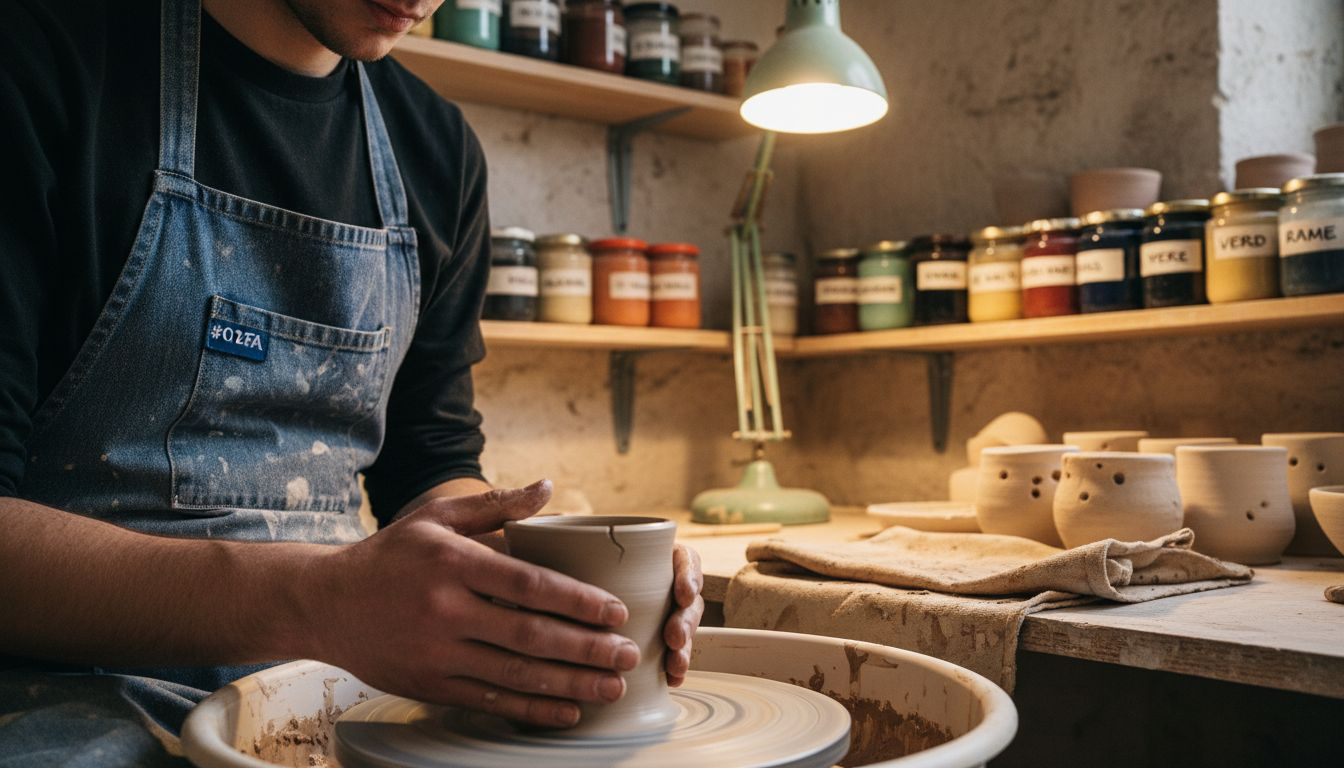
Direct modeling allows for the creation of sculptural forms without a wheel. The artisan shapes the clay with their hands, spatulas, and modeling tools, building the object piece by piece or carving from a solid block. Traditional plaster molds help reproduce complex shapes while maintaining manual control: clay is pressed into the mold by hand, not mechanically injected.
Assembly combines multiple separately modeled elements. Handles, spouts, and decorations are attached to the main body using slip, a mixture of liquid clay that acts as a natural glue. This technique allows for intricate compositions impossible to achieve in a single piece.
Approximately 90% of Italian artisanal ceramics are made manually using these traditional techniques. Preserving these methods ensures the continuity of a cultural heritage that risks disappearing with industrial automation.
Pro Tip: If you're a beginner, focus on mastering one technique before expanding. Four weeks dedicated exclusively to the potter's wheel yield better results than eight weeks split between the wheel and modeling. Depth beats breadth in the early stages of learning.
Participating in a workshop where you can model clay with a local artist greatly accelerates the learning curve. Watching a master center clay or join two pieces teaches you details impossible to grasp from videos.
The Firing and Glazing Process
The transformation of modeled clay into permanent ceramic occurs through firing in a kiln. This step requires precise control of temperature and time to avoid cracks, deformations, or breakages.
The standard process involves:
-
First firing or bisque firing: the dried object is fired between 900°C and 1000°C for approximately 8 hours. This stage removes chemical water from the clay and makes the piece porous but strong, ready to receive the glaze.
-
Glaze application: mixtures of minerals, metal oxides, and fluxes are prepared and applied to the bisqued surface with a brush, by dipping, or spraying. Italian artisans use traditional recipes that include local natural materials.
-
Second firing or glaze firing: the glazed piece is fired between 1000°C and 1300°C depending on the type of clay and glaze. At these temperatures, the glaze melts, vitrifies, and permanently bonds to the ceramic, creating the final glossy or matte surface.
-
Controlled cooling: the kiln must cool gradually for 12-24 hours. Too rapid cooling causes thermal shock that cracks the pieces.
Temperature control is critical. Variations of 20-30 degrees drastically alter glaze color and ceramic strength. Expert artisans read the color of the fire through the kiln's spy holes, a skill that takes years to develop.
The choice of natural materials for glazes preserves traditional aesthetics and ensures food safety. Iron, copper, cobalt, and manganese oxides produce the typical color palette of Italian ceramics: intense blues, coppery greens, ocher yellows, and terracotta reds.
Differences Between Artisanal and Industrial Ceramics
Understanding the fundamental distinctions helps you evaluate the authenticity and value of ceramic objects.
| Characteristic | Artisanal Ceramics | Industrial Ceramics |
|---|---|---|
| Production Control | Total manual control at every stage | Automated processes with minimal supervision |
| Uniqueness | Each piece is unique with natural variations | Identical objects produced in series |
| Production Time | Days or weeks per piece | Minutes per unit |
| Customization | Infinite possibilities on request | Rigid standardization |
| Artistic Value | Signed functional artwork | Anonymous commercial product |
| Cost | Higher due to time and skill required | Lower due to economies of scale |
Artisanal ceramics emphasize human control. The artisan decides thickness, shape, decoration, and finish in real-time, adapting to the specific characteristics of each clay block. This approach generates pieces with distinct personality.
Industrial production optimizes speed and uniformity. Machines press clay into identical molds, robots apply glazes in precise quantities, and tunnel kilns fire hundreds of pieces simultaneously. The result is predictable but lacks character.
Common misconceptions include:
- Believing that "handmade" means imprecise or crude: artisanal mastery produces excellent symmetry and finishing.
- Thinking that artisanal ceramics are too expensive: the price reflects hours of specialized work, not an arbitrary markup.
- Assuming that industrial equals low quality: excellent industrial productions exist, simply lacking uniqueness.
To verify the authenticity of a ceramic piece, look for signs of manual workmanship such as slight asymmetries, variations in thickness, and fingerprints under the base. Certifications like those discussed in examples of craft authentication provide additional guarantees.
Practical Experiences and Workshops in Italy
Participating in practical workshops is the most effective way to truly understand artisanal ceramics. Reading or watching videos doesn't replace the feel of clay between your hands or the immediate feedback from a master correcting your posture at the potter's wheel.
Italian workshops offer different types of experiences:
- Introductory sessions of 2-3 hours: ideal for absolute beginners who want to try the potter's wheel or modeling without a long-term commitment.
- Intensive weekend courses: cover the complete cycle from clay preparation to glazing with the first firing.
- Advanced courses of weeks or months: delve into specific techniques such as raku, maiolica, or ceramic sculpture.
- Thematic workshops: focused on decoration, natural glazes, or ceramic restoration.
Italian regions with a higher concentration of workshops include Tuscany, where medieval traditions survive in Montelupo Fiorentino, Emilia-Romagna with the historic hub of Faenza, and Campania, where Vietrese ceramics maintain vibrant Mediterranean colors.
The benefits of practical learning extend beyond acquiring technical skills. Working with clay reduces stress and anxiety through tactile contact and the required concentration. Creativity explodes when you can experiment directly instead of just imagining. Many participants discover a passion that transforms their free time.
Pro Tip: Choose workshops led by artisans with at least ten years of professional experience. Verify that materials and equipment are provided: buying clay, glazes, and tools before knowing what you need wastes money. Prefer courses with a maximum of 6-8 participants to ensure individualized attention.
Exploring ceramic workshops in Italy allows you to compare offers and find the perfect experience for your level. A basic ceramic lesson is the ideal starting point to test your interest before making larger commitments.
Common Mistakes and Misconceptions About Artisanal Ceramics
Debunking common myths prepares you for a realistic approach that prevents frustration and maximizes learning.
Many believe that ceramics are primarily a decorative aesthetic activity, ignoring the technical complexity. In reality, mastering the potter's wheel requires an understanding of rotational physics, clay plasticity, and fine muscle control. Beauty emerges from technical competence; it doesn't replace it.
The idea that learning the potter's wheel is quick and intuitive disappoints many beginners. Centering the clay, the first essential step, can take weeks of daily practice. Raising uniform walls without unbalancing the piece requires months. Expecting professional results after a few sessions guarantees disappointment.
Some think that artisanal production can match industrial speeds with enough experience. Impossible: manual techniques have inherent physical limits. An experienced potter produces 10-15 pieces a day on the wheel, while a machine stamps hundreds per hour. Speeding up beyond certain limits compromises quality and uniqueness.
Typical beginner mistakes include:
- Using clay that is too wet or too dry: the perfect consistency is learned over time and by feel.
- Applying excessive pressure to the wheel, causing walls to collapse.
- Skipping the gradual drying phase, causing cracks.
- Glazing too thickly, creating runs and defects.
- Opening the kiln before it has completely cooled, causing thermal shock.
To recognize authentic artisanal ceramics, look for these elements:
- Artisan's signature or stamp on the bottom.
- Slightly variable weight between pieces in the same series.
- Small imperfections that attest to manual workmanship.
- Wall thickness that is not perfectly uniform.
- Hand-applied decorations with visible brushstrokes.
- Certificate of authenticity when available.
Patience is the fundamental virtue. Accepting that mastery takes years frees one from the frustration of unrealistic expectations and allows enjoyment of the learning journey.
Discover Ceramic Workshops with Club Joy
If you wish to transform theoretical knowledge into practical experience, Club Joy connects you to the best artisanal ceramic workshops in Italy. You can finally get your hands in the clay, feel the wheel spin, and create unique objects guided by professional artisans.

Our selected workshops offer authentic experiences where you learn traditional techniques in stimulating environments. Whether you want to try a basic ceramic lesson to discover if this art captivates you or immerse yourself in more in-depth courses, you will find the perfect option.
Participation reduces stress, stimulates creativity, and connects you with a community of enthusiasts. Many customers report that ceramics has become their weekly refuge, a space to disconnect from routine and reconnect with the pleasure of creating with their hands.
Explore our ceramic workshops in cities like Milan, Florence, and Rome. Each experience includes materials, tools, and expert guidance. Book today and begin your journey into Italian artisanal ceramics.
Frequently Asked Questions
Why choose artisanal ceramics instead of industrial?
Artisanal ceramics offer uniqueness impossible to replicate industrially. Each piece carries the artisan's personal touch and becomes a functional work of art with superior emotional value. You also support cultural traditions and local crafts instead of anonymous mass production.
How long does it take to learn basic ceramic techniques?
Achieving basic proficiency on the potter's wheel requires 4-12 weeks of regular practice with 2-3 sessions per week. Manual modeling is more accessible and yields satisfactory results after just 3-4 lessons. True mastery comes after years, but creating usable pieces is possible in a reasonable time with proper guidance.
Are ceramic workshops suitable for those without experience?
Absolutely yes. Introductory workshops are specifically designed for absolute beginners with no prerequisites. Instructors guide you step-by-step from clay preparation to your first creation. The hands-on approach makes learning intuitive and fun, even without an artistic background.
How can I recognize authentic artisanal ceramics?
Look for signs of manual workmanship such as slight asymmetries, variations in thickness, and weight between similar pieces. The presence of the artisan's signature or stamp guarantees authenticity. Minor imperfections like small bubbles in the glaze or tool marks confirm a manual rather than industrial process.
What benefits do practical ceramic workshops offer?
Beyond learning technical skills, working with clay reduces anxiety and stress through tactile contact and the meditative concentration required. It stimulates creativity and problem-solving. Many participants experience increased self-esteem by seeing their creations take shape and discovering hidden abilities.
Can I discover local creative hobbies similar to ceramics?
Yes, many platforms like Club Joy offer comprehensive catalogs of creative experiences beyond ceramics. You can explore painting, glasswork, weaving, sculpture, and other manual arts. Trying different hobbies helps you find what resonates most with your natural inclinations and interests.