
Ceramics as a Hobby: Creativity and Well-being in the City
The idea that ceramics are fragile and difficult is a thing of the past. In reality, this inorganic and non-metallic material, typical of creative cities like Milan and Florence, is accessible to anyone who wants to express their imagination with their hands. You'll discover that the variety of clays, colors, and techniques allows you to create unique pieces, debunking false myths about the difficulty and monotony of this hobby. Start truly getting to know ceramics and transform your free time into an engaging creative experience.
Table of Contents
- What is Ceramics: Definition and False Myths
- Types of Ceramics: Terracotta, Majolica, Stoneware, and Porcelain
- Creative Processes and Essential Tools
- Psychological, Social, and Manual Benefits
- Risks, Costs, Common Mistakes, and Safe Practices
- Creative Alternatives and Recent Trends
Key Points
| Point | Details |
|---|---|
| Ceramics are accessible to everyone | In many Italian cities, anyone, without experience, can learn to work with ceramics through practical courses. |
| Types of ceramics and useful applications | Choosing the type of ceramic, such as terracotta or stoneware, influences difficulty and final use. |
| Psychological and social benefits | Ceramics not only improve manual skills but also promote mental well-being and social connection. |
| Safety and recommended practices | It is essential to be aware of risks and adopt safety practices to prevent injuries while working with ceramics. |
What is Ceramics: Definition and False Myths
Ceramics are an inorganic, non-metallic material that becomes rigid and resistant after firing. It is composed of clays, feldspars, silica sand, and other natural components that undergo a complete transformation during the kiln firing process.
This is not a hobby reserved for a few experts. Thousands of people in Milan, Florence, and other Italian cities discover each year that anyone can work with ceramics, regardless of prior experience.
The Types of Ceramics You Will Encounter
Ceramics encompass various types, each with specific characteristics:
- Terracotta: porous, easy to shape, perfect for beginners
- Stoneware: more durable, less absorbent, ideal for everyday objects
- Porcelain: refined, delicate, requires greater precision
- Majolica: decorated with glazes, traditional in Italian arts
Each type has different porosity and characteristics. The choice depends on what you want to create and your experience level.
The False Myths You Must Abandon
False Myth #1: Ceramics are always fragile
Some types of ceramics have high resistance and excellent impermeability. Stoneware, for example, is virtually indestructible and perfect for everyday plates and glasses. Fragility depends on the material choice, not on ceramics in general.
False Myth #2: It's extremely difficult to learn
Many believe it requires years of training. The reality? You'll create your first simple shapes in your very first lesson. With just a few hours of guided practice, you'll be able to model recognizable and functional objects.
False Myth #3: The color is always the same
Colors and finishes vary enormously depending on the materials used and the glazes applied. You can achieve natural tones, vibrant colors, rough textures, or glossy, mirror-like surfaces.
False Myth #4: You need a gigantic space
You don't need a dedicated room. Ceramic studios in the city have all the necessary equipment. You go to class, create your piece, and the staff does the rest.
Understanding the processes and components of ceramics is the first step to truly understanding this material and stopping believing the wrong myths.
Professional Tip: Before enrolling in a course, visit two different studios in your city. Touch the materials, observe how the instructors work, and choose the space that makes you feel most comfortable: the right environment makes all the difference.
Types of Ceramics: Terracotta, Majolica, Stoneware, and Porcelain
Not all types of ceramics are created equal. Discovering the differences helps you choose the right material for your first project and understand why some objects last a lifetime while others break easily.
Ceramics are divided into two broad categories: porous body ceramics and dense body ceramics. This fundamental distinction determines how you will work the material and what you can create.
Terracotta: The Perfect Starting Point
Terracotta is the best choice for beginners. It is porous, easy to model, and more forgiving of mistakes than other types.
Main characteristics:
- Natural red-orange color
- Very absorbent, perfect for pots and garden objects
- Can be scratched if not handled carefully
- Works like soft butter
Many decorative terracotta pots are customized after firing with additional techniques.
Majolica: Tradition and Decoration
Majolica is the quintessential decorated ceramic, rooted in Italian tradition. It is still porous, but covered with glazes that make it colorful and fascinating.
Its characteristics:
- Glazed surface with vibrant colors
- Traditionally Italian, with geometric and floral designs
- Requires two firings: first the bisque, then the glaze
- Ideal for those who want to add art to their work
If you love details and visual creativity, majolica is your choice.
Here is a brief overview of the main types of ceramics and their ideal uses:
| Type of Ceramic | Difficulty Level | Recommended Use | Final Appearance |
|---|---|---|---|
| Terracotta | Very Easy | Garden pots, decorative objects | Matte, warm, and earthy |
| Majolica | Easy | Ornamental plates, decorated objects | Glossy, vibrant colors |
| Stoneware | Intermediate | Everyday dishes, sturdy mugs | Matte or satin, neutral |
| Porcelain | Advanced | Collector's items, delicate porcelain | Brilliant, pure white |
Stoneware: Robustness and Versatility
Stoneware is a dense body ceramic, much more durable than terracotta. It is practically impermeable and resistant, which makes it perfect for everyday objects.
Reasons to love stoneware:
- Does not absorb water: you can create plates, glasses, bowls
- Natural gray or beige color
- Resistant to impacts and thermal shocks
- Used for both decorative and functional creations
Stoneware is the perfect compromise between ease of processing and durability over time, ideal for those who want long-lasting objects.
Porcelain: Elegance and Precision
Porcelain is the most refined and difficult type to work with. It comes in two variants: soft-paste porcelain and hard-paste porcelain, both with high resistance and a glossy finish.
When to choose it:
- You seek elegance and refinement
- You already have experience with other types
- You want to create objects that last for generations
- You appreciate delicate work and precision
Porcelain requires more control, but the final result is extraordinary.
Which to choose for your first course?
If you are a beginner, start with terracotta or stoneware. Both give you room for error and teach you the basics without stress.
If you want immediate and colorful visual results, try majolica.
Save porcelain for when you have gained confidence and technique.
Professional Tip: During your first lesson in the studio, ask the instructor to let you touch and compare all these materials. Understanding the consistency and reactivity of each with your hands is more important than reading about it: you will immediately feel which one you like best.
Creative Processes and Essential Tools
The magic of ceramics happens when you combine the right creative process with the right tools. You don't need a room full of expensive equipment: you need the right tools, used in the right way.
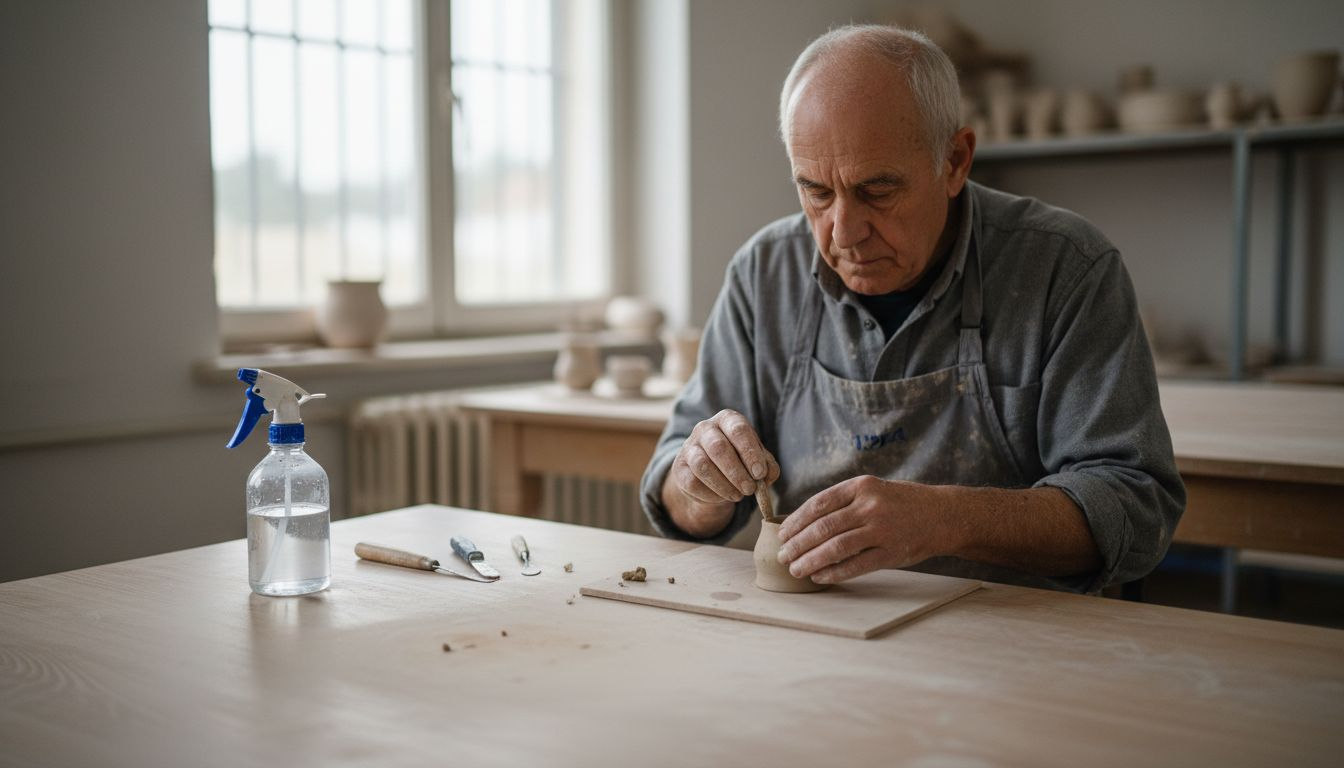
The journey from raw clay to finished object follows precise steps. Understanding each phase gives you the creative control you desire.
The Creative Process: From Shaping to Firing
Every piece of ceramic goes through five essential phases: preparation, modeling, drying, decoration, and firing.
Clay preparation: You start by conditioning the clay, removing air bubbles that could cause the piece to burst in the kiln. This step seems tedious but changes everything.
Modeling: This is where true creativity comes into play. You can use three different approaches:
- Freehand modeling: sculpt with your fingers
- Wheel throwing: the rotating wheel creates symmetrical shapes
- Coiling and slab building: construct the piece by assembling prepared pieces
Drying: The clay must dry slowly before going into the kiln. If you speed it up, the piece will crack. If you make it wet again, you can continue working.
Decoration: Add details, textures, colors with brushes and glazes.
Double firing: First firing at a low temperature (bisque firing makes the clay porous), second firing at a high temperature to set the glazes.
Essential Tools
You don't need to buy anything before you start. The best ceramic studios provide everything. But knowing these tools makes you aware of what you are doing.
Essential tools for forming:
- Potter's wheel: the rotating wheel for symmetrical shapes
- Natural sponges: smooth and moisten
- Carving tools: knives, spatulas, needles for details
- Wire: cuts clay straight
- Pliers: help handle delicate pieces
For decoration:
- Natural brushes of various sizes
- Glazes and underglazes in colors you love
- Sponges for texture effects
Control of the creative process depends on the quality of your tools: the wrong tool turns a brilliant idea into frustration.
Red or white clay: which to choose?
Red clay: Softer, more forgiving of mistakes, natural warm color. Perfect for beginners.
White clay: More difficult to work with, more refined result, perfect for decorative porcelain.
In your first courses, you will use what the studio provides. Don't worry about the choice: you will learn to recognize which one you prefer while working.
Professional Tip: During the lesson, observe how the instructor prepares the clay and moistens the piece while working. These small gestures determine 70% of your success: it's not magic, it's repeatable technique.
Psychological, Social, and Manual Benefits
Ceramics isn't just about creating beautiful objects. It's a powerful tool for transforming your mental well-being, connecting with other people, and developing skills that you'll feel in your hands forever.
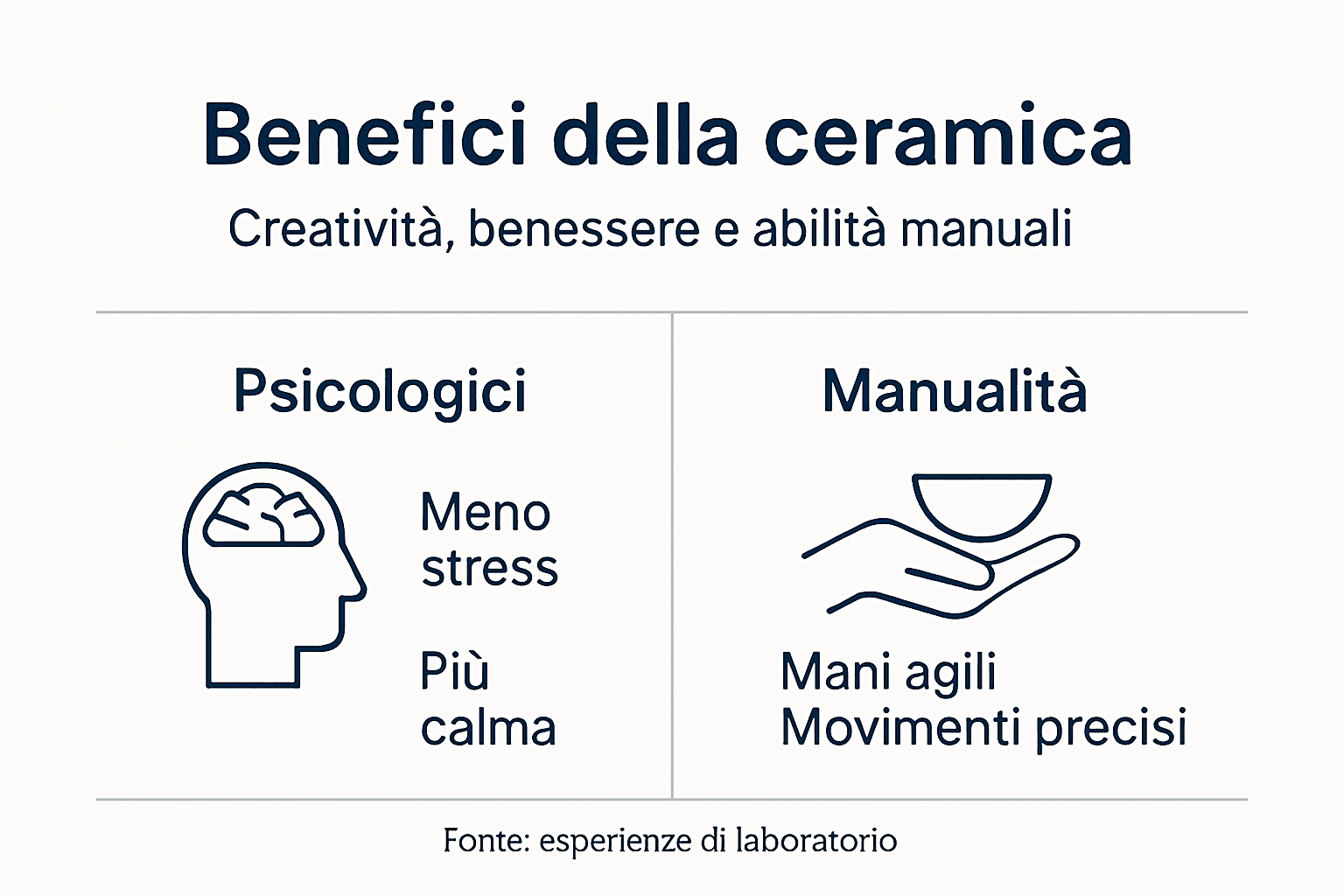
When you model clay, you're not just shaping matter. You're shaping yourself.
The Brain and Hands: Neuroplasticity in Action
Modeling clay stimulates your brain in ways other activities don't. Ceramic work improves neuromotor skills and activates deep cognitive processes.
What happens physically:
- Improves fine motor control: your fingers learn new movements
- Increases concentration capacity: the brain enters a meditative state
- Develops tactile memory: hands remember shapes
- Strengthens hand-eye coordination: you see and adapt simultaneously
This isn't boring. It's your mind rewiring itself, neuron by neuron.
Stress, Anxiety, and Calm: The Real Psychological Benefits
Ceramics acts as a biological outlet. While your hands work, your mind calms down.
The practice of ceramics reduces stress and anxiety in a documented way. It's not a placebo: it's physiology.
Why it works:
- Clay responds to your movements, creating immediate and tangible feedback
- The rhythmic repetition of gestures induces a natural meditative state
- You create something permanent from nothing: self-esteem increases
- You don't think about work, problems, anxieties: you are totally present
A two-hour lesson is worth two weeks of talk therapy for many.
The Social Aspect: Creative Community in the City
In ceramic studios in Milan, Florence, and other Italian cities, you'll meet other people like you: creative, curious, seeking meaning.
Concrete social benefits:
- Meet people with common interests in a non-competitive context
- Share the creative process, not just the result
- Learn from others' mistakes and successes
- Form friendships based on something tangible
Unlike social networks, here the connection is real. You get your hands dirty together.
Ceramics is a bridge between isolation and community: you are not alone, but neither are you judged.
Manual Skills: Your Growing Advantage
Every lesson develops skills you never had. Your hands become smarter, more skillful, more aware.
What you develop:
- Increased tactile sensitivity
- Strength in fingers and wrists
- Ability to solve physical problems in real time
- Body awareness in space
These skills stay with you. After the first course, your hands will never be the same.
Below is a table comparing the psychological, social, and manual benefits of ceramics:
| Benefit | What it improves | Long-term effects |
|---|---|---|
| Psychological | Concentration, anxiety reduction | Greater emotional self-control |
| Social | New relationships, sense of community | Creative support network |
| Manual | Motor skills, tactile sensitivity | Less muscle stress, more precise fingers |
Professional Tip: Don't worry if your first pieces aren't perfect. Beauty is not the prize: the psychological well-being you'll feel while modeling is the true gift. Every lesson, repeat this phrase: "I'm retraining my brain," because that's exactly what you're doing.
Risks, Costs, Common Mistakes, and Safe Practices
Ceramics are safe, but not entirely risk-free. Like any manual activity, it presents specific challenges you need to be aware of before starting. The good news? All these risks are manageable with awareness and simple precautions.
You shouldn't be afraid of them. You should be aware of them.
Physical Risks: What Happens to Joints
Working with ceramics involves repeating certain movements many times. Repetitive movements can cause joint problems if you're not careful.
Common risks related to ceramic work:
- Tendonitis: inflammation of shoulder and wrist tendons from repetitive rotations
- Back problems: incorrect posture while modeling for extended periods
- Neck pain: constant downward tilting
- Muscle fatigue: arm muscles work intensely
These risks are almost always long-term, not immediate. One lesson won't hurt you. It's hundreds of lessons without precautions that create problems.
Chemical risks: dust and glazes
You don't see the danger, but it's there. Working with ceramic materials involves risks related to inhaling dust and contact with chemicals in glazes.
What you need to know:
- Clay dust: when you dry and smooth pieces, dust flies
- Glazes and underglazes: contain heavy metals and toxic substances if ingested
- Fumes from the kiln: firing at high temperatures releases vapors
- Skin contact: some glazes cause irritation with prolonged exposure
In good ceramic studios, ventilation is built into the system. Always ask.
Safety practices that really work
It's not complicated. It's a few gestures that protect your body over time.
Essential precautions:
- Adequate ventilation: ensure the space has circulating air
- Dust masks: use an FFP2 mask when handling dry clay
- Protective gloves: protect against glaze irritation
- Conscious posture: sit up straight, not hunched over the table
- Frequent breaks: stretch your arms, move your neck every 20 minutes
- Hygiene: wash your hands before eating, don't touch your face while working
- Workspace cleaning: wet dust, don't sweep
Safety is not something you add on afterwards. It's something you build into your way of working from day one.
The real costs: what to expect
Ceramics is not expensive if done in the right studios. A basic lesson costs between 30 and 60 euros in Italian cities like Milan and Florence.
Cost breakdown:
- Single lesson: 30-60 euros (materials and tools included)
- Monthly course (4 lessons): 100-180 euros
- Quarterly course: 250-400 euros
- Public kilns: 5-15 euros for additional firing
Don't buy personal equipment at first. Studios provide everything. If you continue after 6 months, then consider investing in your own tools.
Common mistakes that ruin the experience
Many beginners make the same mistakes. Avoiding them makes your experience better.
Mistakes to avoid:
- Accelerating drying: your piece will crack in the kiln
- Inconsistent thickness: a thick part shrinks differently from a thin one
- Ignoring cleanliness: clay scraps ruin the kiln
- Excessive pressure: you force the wheel, the piece breaks
- Over-glazing: the glaze drips onto the kiln floor
- Starting too big: a failed large vase is more discouraging than many small successes
Professional tip: During the first lesson, ask the instructor where the ventilation, masks, gloves are, and how they clean up scraps. A space that doesn't have these elements shouldn't be your studio. The safety of the place reflects the value the studio places on its customers.
Creative alternatives and recent trends
Ceramics is not static. While you discover this hobby, the world of ceramic design evolves. In 2025, trends reflect what many enthusiasts are looking for: sustainability, authentic craftsmanship, and a return to natural textures.
Knowing these trends helps you understand where your creativity is going and which directions to explore in the coming months.
Sustainability and environmental awareness
Natural materials and ecological approaches are no longer options. They are at the center of the creative conversation.
Trends reflect a genuine focus on the environment:
- Local clays and recycled materials gain value
- Zero waste ceramics: scraps become resources for new projects
- Non-toxic and bio-based glazes dominate conscious choices
- Durable pieces, not single-use
When choosing a studio, ask if they use sustainable materials. It's a choice that matters.
The return to manual skills and artisan textures
As technology advances, the desire for human traces grows. Artisan textures, controlled imperfections, and hand marks are now protagonists of design.
This means:
- Fingerprints on the piece are not errors, they are a signature
- Rough surfaces inspired by natural stone and wood are more appealing than polished ones
- Sculptural forms and Art Deco influences emerge in contemporary design
- The movement of the hand during creation is visible and appreciated
If you start learning hand-building today, you are already aligned with the most important trend of the moment.
Colors and palettes: from natural to vibrant
Ceramic colors in 2025 range from neutral and earthy tones to vibrant and unexpected palettes.
Color trends:
- Natural tones: beige, gray, off-white reflecting raw clay
- Bold palettes: electric blue, sage green, intense reds for the brave
- Gloss and matte mixed together in the same piece
- Shades that recall minerals and geological surfaces
Color choice is personal, but now you have the freedom to range from minimalist to dramatic.
Creative alternatives: beyond traditional ceramics
If classical ceramics are not enough for you, hybrid creative alternatives are emerging.
Options that combine ceramics with other mediums:
- Ceramics + epoxy resin: hybrid surfaces with liquid effects and transparencies
- Ceramics + painting: post-firing decoration with mixed techniques
- Ceramics + metal: copper, gold, silver inserts in the piece
- Ceramics + natural fibers: fabrics incorporated into the structure
- Raku ceramics: smoking and oxidation for dramatic effects
Modern ceramics recognizes no sharp boundaries. Hybrid is the new pure.
Where to find inspiration and online community
Physical studios remain the heart, but online communities drive creative vision.
What to follow and where to look:
- Profiles of contemporary ceramicists who experiment
- Hashtags like #contemporaryceramics and #makingceramics for discovery
- Design blogs that document global trends
- Online workshops with international masters
But remember: the screen inspires you, hands in clay transform you.
Professional tip: After the first basic lessons, ask your studio to propose a project with at least one "hybrid" technique you've never tried. It could be mixed decoration, bold colors, or unusual textures. Personal innovation begins when you step out of your comfort zone, not when you stay only with the basics.
Discover creativity and well-being with ceramic workshops at your fingertips
If the desire is to transform daily stress into moments of relaxation and creativity, ceramics is the ideal path. As highlighted in the article, ceramics helps improve concentration, hand-eye coordination, and reduces anxiety through a manual process that develops tactile and social skills. For those looking to start modeling clay without fear of complexity or bulky equipment, guided lessons and the safe environment offered in studios in cities like Milan and Florence are essential.
Join the Club Joy community now and choose your Ceramics workshop where you can experience techniques from wheel-throwing to decoration with materials suitable for every level. Take advantage of the creative experiences designed to guide you step-by-step towards tangible and lasting results. Don't wait for creativity to stop, act now and transform your free time into a moment of true psychological and manual well-being by visiting Club Joy and booking your first practical experience today.
Frequently Asked Questions
What are the main benefits of working with ceramics as a hobby?
Working with ceramics offers numerous benefits, including improved fine motor skills, stress and anxiety reduction, and the opportunity to socialize with other creative people. It also stimulates creativity and concentration skills.
Is it difficult to learn to work with ceramics?
No, it's not difficult. It's accessible to everyone, and it's possible to create simple shapes even in the first few lessons. With a little guided practice, anyone can create recognizable and functional objects.
What is the best type of ceramic for beginners?
Terracotta is generally the best choice for beginners. It is easy to model, porous, and forgives mistakes better than other ceramics. Alternatively, stoneware is also a good option for those seeking more durable materials.
What tools are needed to start working with ceramics?
You don't need expensive tools to start, ceramic studios provide everything necessary. However, essential tools include wheels, natural sponges, spatulas, and brushes for decoration.