
Origins of Painting Workshops: From Tradition to Creative Experience
In the life of every art enthusiast, there comes a time to seek a space where they can freely experiment with what they feel inside. Today, painting workshops combine the rich tradition of historical Italian workshops with contemporary practicality, giving a voice to anyone who wants to approach creativity without barriers. Here, creative facilitation replaces the imposition of method, and every artist finds the opportunity to grow in a welcoming and stimulating environment.
Table of Contents
- What a Painting Workshop Is Today
- From Medieval Workshops to Modern Studios
- Main Types of Art Workshops
- Social and Cultural Role in Local Contexts
- Common Mistakes and Risks in Creative Experiences
Key Takeaways
| Points | Details |
|---|---|
| Accessible Workshops | Modern workshops are open to beginners and offer a welcoming environment for all skill levels. |
| Practical Learning | Learning by doing, with an emphasis on practical techniques rather than theory. |
| Importance of Social Interaction | Workshops encourage the sharing of creative experiences and interactions among participants. |
| Risks of a Perfectionist Approach | Avoiding perfectionism allows for exploration and experimentation without fear of making mistakes. |
What a Painting Workshop Is Today
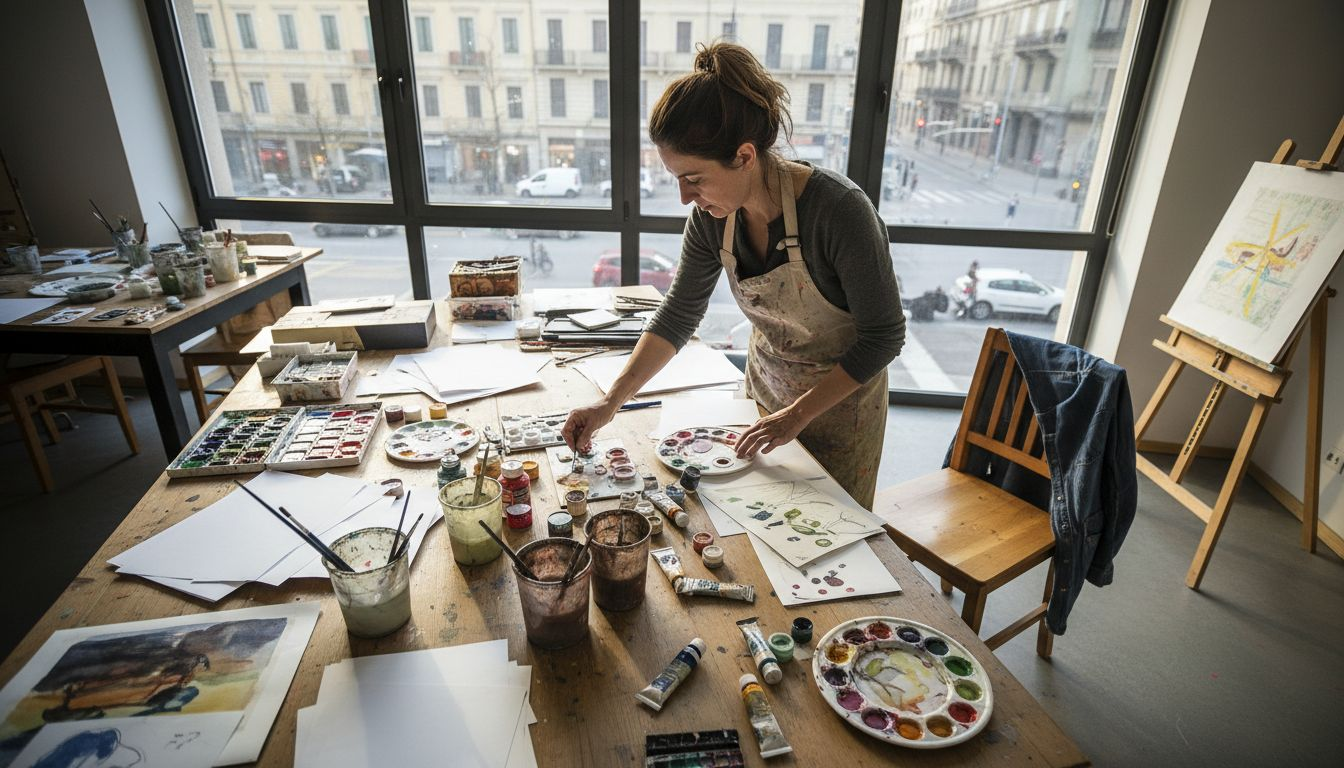
A contemporary painting workshop is not just a space where people paint. It's a creative experience where people of all levels discover their artistic talent in a welcoming and structured environment.
Unlike traditional academic courses, modern workshops offer flexibility and inclusivity. No prior skills are needed: every participant is guided through practical techniques, from canvas preparation to color selection, all the way to the final brush strokes.
Key elements of a painting workshop today include:
- Accessibility: Open to beginners, not just experienced artists
- Immediate Practice: Learning by doing, not by listening to theoretical lectures
- Social Interaction: Sharing space and experiences with other enthusiasts
- Variety of Techniques: Watercolor, oil, acrylic, and experimental methods
- Creative Atmosphere: A space where mistakes are part of the learning process
Today, when you search for a painting workshop in Italy, you'll find options ranging from short workshops lasting a few hours to continuous lesson cycles. Some workshops focus on specific themes, such as painting on canvas or particular expressive techniques.
A modern painting workshop is less about "teaching" and more about "creative facilitation"—the instructor accompanies your artistic journey, rather than imposing it.
Many contemporary workshops also cater to companies looking for creative team-building activities. The space becomes a place where colleagues discover new aspects of themselves through art, transforming an artistic experience into a moment of authentic connection.
The physical structure of these spaces plays an important role. You'll find well-lit work tables, quality materials available, and an organization that minimizes stress and maximizes enjoyment. It's not uncommon for the social element—conversations among participants, coffee breaks—to become as important as the artistic creation itself.
Professional tip: When choosing a workshop, check if the instructor adapts their teaching to the participants' levels and if the environment conveys calm and welcome, not competition.
From Medieval Workshops to Modern Studios
In the Middle Ages, art workshops were the beating heart of artistic creation. Master artisans welcomed young apprentices into spaces where techniques and secrets were passed down from generation to generation, through direct observation and daily practice.
These workshops followed a strict hierarchical organization. The apprentice started with simple tasks—grinding pigments, preparing canvases—and gradually progressed to more complex techniques under the master's guidance.
The main characteristics of medieval workshops were:
- Oral Transmission: Knowledge passed directly from master to disciple
- Narrow Specialization: Each workshop was known for a specific technique
- Material Self-Sufficiency: Artisans produced their own paints and preparations
- Community Link: Workshops were the foundation of the local economy
- Long Training Cycle: It could last years before becoming independent masters
The transformation towards modern studios has been gradual but significant. Over time, medieval workshops evolved by integrating new teaching methodologies, technological tools, and more flexible organizational models.
Today's workshops retain the collaborative spirit of the old workshops but eliminate hierarchical rigidity, creating spaces accessible to everyone.
Today, workshops have different purposes. They don't just produce works for the market, but facilitate personal creative experience. The transmission of knowledge still occurs in a practical way, but it is integrated with theoretical explanations, video tutorials, and digital resources.
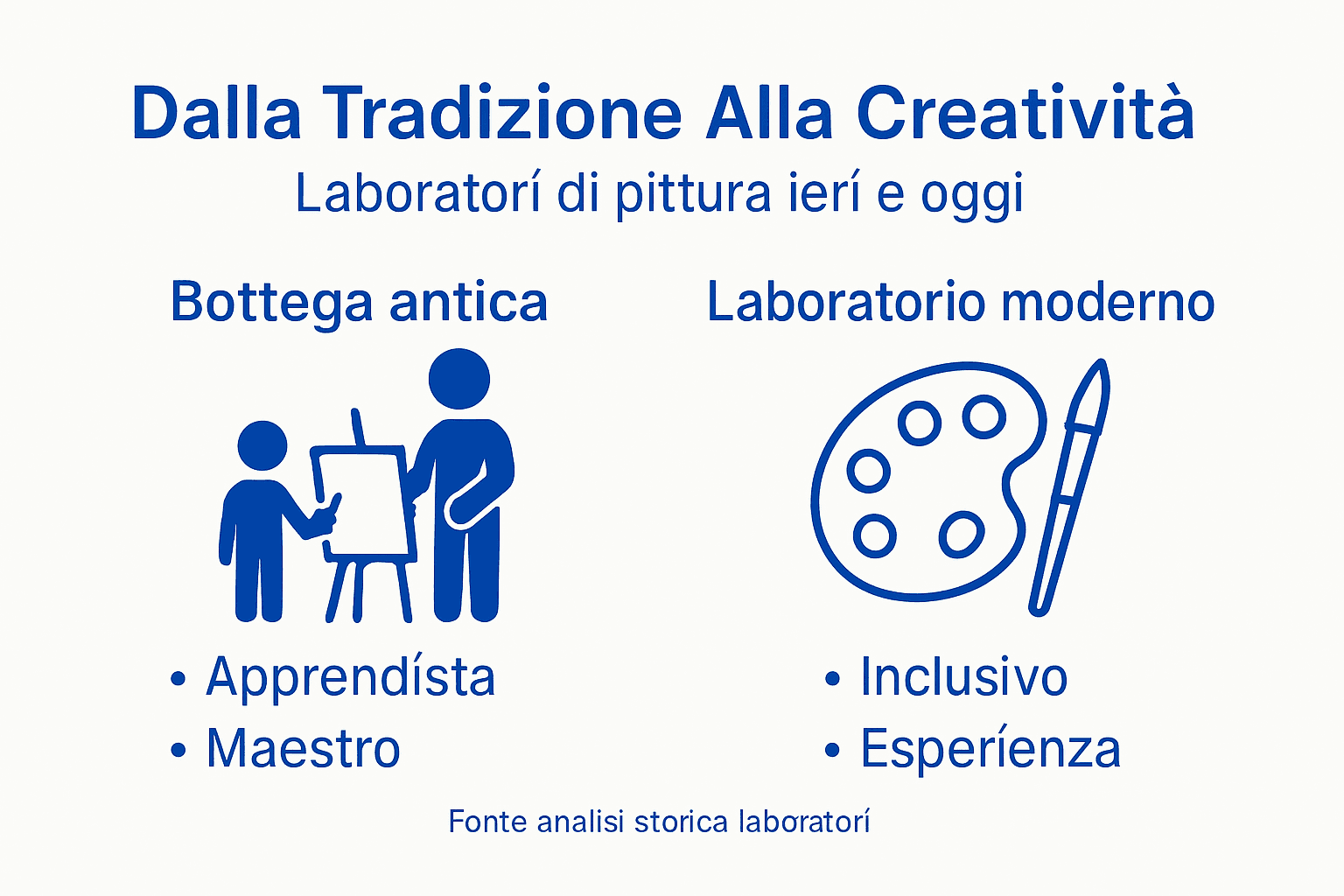
The modern structure reflects cultural changes: inclusivity instead of selection, experimentation instead of repetition, sharing instead of secrecy. Teachers are no longer just artisans, but facilitators of creative processes who guide different skill levels simultaneously.
This evolution is not a loss. Rather, it transforms the workshop into a space where artisanal tradition meets the democratization of art, allowing anyone to discover their talent.
Here's an overview of the differences between medieval workshops and modern studios:
| Key Aspect | Medieval Workshop | Modern Studio |
|---|---|---|
| Teaching Method | Oral and direct transmission | Creative and inclusive facilitation |
| Teacher's Role | Master with hierarchical authority | Flexible, non-authoritarian guide |
| Duration of Training | Years of apprenticeship | From short workshops to long courses |
| Main Goal | Production for local market | Personal and social development |
| Access | Strict selection of apprentices | Open to all levels |
Professional tip: Look for workshops that respect artisanal fundamentals—direct practice, one-to-one teaching, and attention to detail—while being open to all levels of experience.
Main Types of Art Workshops
Not all art workshops are the same. Each type responds to different purposes, from workshops dedicated to painting to those exploring graphic, plastic, and multimedia techniques.
Contemporary creative spaces are divided into main categories, each with specific characteristics and objectives. Knowing these differences helps you choose the experience best suited to your interests.
Here are the main types you'll find available:
- Painting Workshops: Focused on painting techniques with oil, acrylic, watercolor, and other traditional painting disciplines
- Graphic Workshops: Dedicated to expressive drawing, printing techniques, and graphic representation
- Plastic Arts Workshops: Focused on sculpture, modeling, and manipulation of three-dimensional materials
- Multimedia Workshops: Combining traditional techniques with digital tools and contemporary experimentation
- Thematic Workshops: Focused on specific subjects such as portraiture, landscape, or decorative techniques
Educational art workshops are structured in various models that stimulate creative expression through practical experimentation. Some are structured as continuous training cycles, others as intensive workshops lasting a few hours.
Choosing the right workshop depends on your goal: do you want to learn a specific technique, explore your creativity, or seek a social space for artistic sharing?
Some workshops focus on pure manual practice, where the master guides you step by step. Others adopt a more free and experimental approach, where you discover your artistic voice with non-directive support.
Workshops aimed at companies and teams have different dynamics. The goal is not always to become artists, but rather to create connection, stimulate creative thinking, and offer a refreshing break from routine.
The duration varies enormously. Three-hour workshops allow you to taste a technique, while monthly or quarterly cycles progressively deepen skills. Some workshops also offer personalized courses upon request.
Professional tip: Before signing up, clarify what you want: to learn a specific skill, relax through creativity, or connect with a community of enthusiasts. The answer will guide your choice.
Social and Cultural Role in Local Contexts
Painting workshops are not isolated spaces dedicated solely to art. They are places where local communities meet, transform, and build authentic bonds around shared creativity.
In urban and peripheral contexts, these spaces play a fundamental role. Collective artistic practice generates a sense of belonging and inclusion, especially among those who normally remain on the margins of society.
Workshops foster multiple dimensions simultaneously:
- Social Inclusion: Involve vulnerable individuals, youth, and marginalized people in regenerative creative processes
- Urban Regeneration: Transform dilapidated spaces into vibrant centers of encounter and creation
- Intercultural Dialogue: Overcome linguistic and cultural barriers through the universal language of art
- Personal Empowerment: Increase self-esteem and awareness in participants
- Community Building: Create lasting and meaningful social networks
Art as a tool for integration facilitates the inclusion of minorities, people with disabilities, and marginalized groups, generating psychological well-being and a more cohesive society. A workshop is not just a course: it is a therapeutic space where emotional benefit equals artistic benefit.
When a local community has access to shared creative spaces, the bond between people and the collective sense of identity increases.
In Italy, many workshops arise from local initiatives that recognize this value. Some originate in peripheral areas to combat isolation, others in historic centers to preserve local artisanal traditions and involve younger generations.
Workshops run by local artists have a particular impact. They become models of possibility for those living in the area, showing that creativity is viable and valued.
The collective practice of painting breaks contemporary isolation. In a workshop space, spontaneous conversations naturally arise between people who might otherwise never meet.
Professional tip: Choose workshops rooted in the local community, managed by local artists who understand the specific dynamics and needs of your area.
Here is a summary of the main objectives in contemporary art workshops:
| Workshop Purpose | Brief Description | Main Benefit |
|---|---|---|
| Technical Learning | Improve mastery of materials and methods | Advanced artistic skills |
| Creativity Development | Stimulate personal expression | Strengthened artistic identity |
| Social Integration | Promote inclusion among different groups | Cohesion and belonging |
| Psychological Well-being | Regenerative experiences through art | Stress reduction |
| Corporate Team Building | Group activities for companies | Collaboration among colleagues |
Common Mistakes and Risks in Creative Experiences
Many people avoid painting workshops for fear of making mistakes. They think that art requires perfection from the first stroke, but this belief completely blocks creativity.
Error is not a failure in creative experiences. It is the very engine of the artistic process that generates unexpected discoveries and personal progress.
Common mistakes in workshops include:
- Paralyzing Perfectionism: Waiting for the "right" moment to start, endlessly postponing
- Comparison with Others: Looking at others' work and feeling inadequate
- Unrealistic Expectations: Thinking of achieving professional results in the first lesson
- Rigidity in the Process: Refusing to experiment because it doesn't match the original plan
- Early Abandonment: Quitting after one or two unsuccessful attempts
Errors and failures in art are intrinsic and productive elements in the creative process. Recognizing creative risk as necessary for innovation allows mistakes to be transformed into opportunities for growth.
The fear of error does not protect against disappointment. Instead, it turns every attempt into a wasted opportunity to learn something new.
A practical risk is choosing poor quality materials. Bad brushes and cheap paints frustrate beginners, creating the impression that the fault is their own when it is actually the tool's.
Some workshops pose psychological risks. If the teacher is critical rather than encouraging, the participant internalizes the message that they are not "good," blocking future creativity.
Organizational risks also emerge. Rushed workshops, without space to explore, transform the experience into a task list rather than an authentic creative journey.
The solution is not to avoid risks, but to face them consciously. The best workshops create environments where error is celebrated as part of the process.
Professional tip: Before signing up, ask the workshop how they handle mistakes and what atmosphere they promote. A teacher who laughs at their own mistakes while working is teaching you more than a thousand words.
Discover How to Experience the Tradition of Painting Workshops with Unique Creative Experiences
The history of medieval workshops teaches us that creativity stems from practice and sharing. Today, the true goal is to transform that ancient tradition into a personal journey of expression and discovery. If you are looking for a painting workshop where you can experiment without fear, develop your creativity, and immerse yourself in a welcoming environment, now is the right time to act.
On Clubjoy, you will find a wide selection of workshops and art labs designed for all levels. You can choose from experiences that combine practical teaching and creative freedom to cultivate talent with quality materials and instructors who guide you step by step. If you also want to explore other manual arts or activities for well-being and team building, discover creative experience offerings in various Italian cities like Milan and Florence. Start building your artistic journey now and turn your free time into a gift for yourself.
Frequently Asked Questions
What are the main differences between modern painting workshops and medieval workshops?
Modern painting workshops focus on creative facilitation, inclusivity, and immediate practical application, while medieval workshops relied on oral transmission of techniques and a rigid hierarchical organization.
How have teaching methods in painting workshops changed over time?
Teaching methods have evolved from an approach based on rigidity and the master's authority to a more flexible and collaborative model, where the instructor acts as a guide rather than an authoritarian figure.
What techniques can be learned in modern art workshops?
In modern art workshops, various techniques can be learned, such as oil painting, watercolor, acrylic, expressive drawing, sculpture, and multimedia techniques.
How do painting workshops contribute to the social well-being of the community?
Painting workshops promote social inclusion, revitalize urban spaces, foster intercultural dialogue, and build community networks, thereby contributing to collective well-being.